Table of contents
The decision to replace a broken or aging gas boiler is no longer a simple like-for-like swap. With rising energy costs, a focus on efficiency, and government targets to phase out fossil fuels, homeowners are increasingly searching for the facts on replacing their existing system with a green alternative.
For those with a gas boiler, the biggest question is: Should I install a new gas boiler, or upgrade to an Air Source Heat Pump (ASHP)?
This comprehensive guide breaks down the true comparison between these two heating systems across the three factors that matter most to prospective upgraders: Cost, Efficiency, and Home Suitability.
Ready to find out your true cost?
Get a Free, Personalized Heat Pump Quote & Grant Assessment Today!
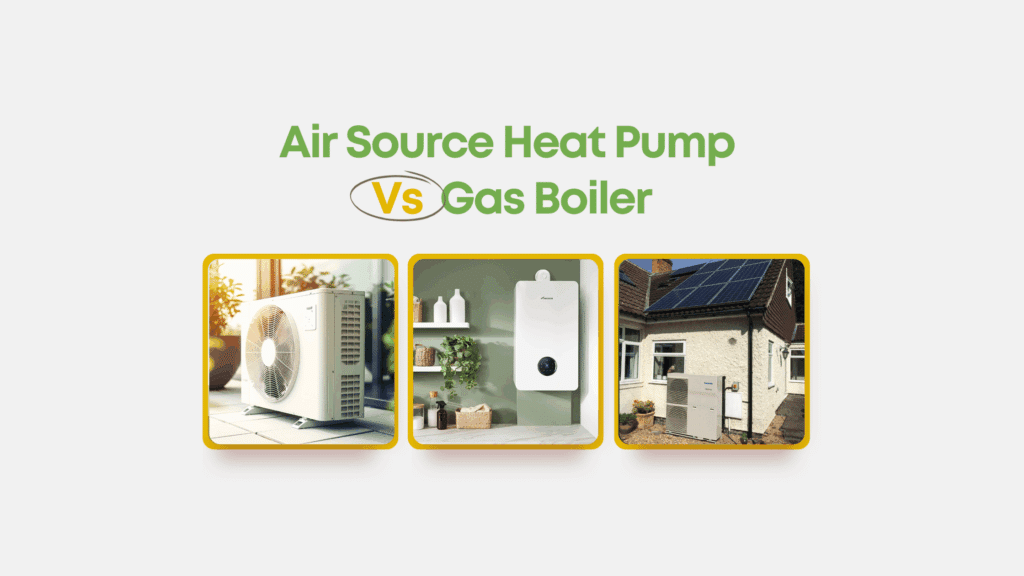
1. How They Work: The Fundamental Difference in Heating
The cost is typically the biggest barrier to a heat pump upgrade. Here is a full breakdown of the financial differences:
Upfront Installation Costs
|
Feature |
Gas Boiler |
Air Source Heat Pump (ASHP) |
|
How it Works |
Burns natural gas to create heat. |
Uses electricity to extract heat from the outside air and move it indoors. |
|
Energy Source |
Natural Gas |
Natural Gas |
|
Energy Efficiency |
Up to 93% (A-rated models) |
300% to 420% (Measured by COP) |
|
Environmental Impact |
High CO2 emissions. |
Low CO2 emissions (Zero-carbon if running on renewable electricity). |
The Power of Efficiency (The COP)
A new gas boiler is highly efficient, converting almost all the gas it burns into heat. However, it can never exceed 100% efficiency.
An Air Source Heat Pump, by contrast, doesn’t create heat; it moves it. For every 1 unit of electricity it consumes, it typically generates 3 to 4.2 units of heat energy. This is known as a Coefficient of Performance (COP) of 3 to 4.2. This incredible efficiency is the core reason why heat pumps are viewed as a long-term solution.
2. Cost Comparison: Upfront Price vs. Long-Term Running Costs
The cost is typically the biggest barrier to a heat pump upgrade. Here is a full breakdown of the financial differences:
Upfront Installation Costs
|
System |
Average Installation Cost (Pre-Grant) |
Government Grant Available (UK/England & Wales) |
Average Homeowner Cost (Post-Grant) |
|
New Gas Boiler |
£2,000 – £4,000 |
None |
£2,000 – £4,500 |
|
Air Source Heat Pump |
£8,000 – £15,000 |
£7,500 (Boiler Upgrade Scheme) |
£500 – £7,500 (Dependent on installer and complexity) |
The initial investment for a heat pump is substantially higher. However, the UK Government’s Boiler Upgrade Scheme (BUS) offers a generous £7,500 grant to eligible homeowners in England and Wales, which can bring the final cost down to a figure much closer to a high-end boiler installation, making the switch much more accessible.
Running Costs: Is a Heat Pump Cheaper to Run?
This is one of the most critical search queries for prospective customers, and the answer is complex:
- Fuel Price Disparity: Electricity (which powers a heat pump) is typically more expensive per unit (kWh) than natural gas.
- Efficiency Advantage: The heat pump’s 300%+ efficiency counteracts the higher electricity price.
The Verdict: A well-designed and correctly installed heat pump system in a well-insulated home will typically be cheaper to run than a standard gas boiler.
|
Scenario |
Gas Boiler Annual Running Cost (Average) |
ASHP Annual Running Cost (Average) |
Potential Annual Saving |
|
New A-rated Boiler vs. Average ASHP |
£1,190 |
£1,105 |
Marginally cheaper (£85) |
|
Old G-rated Boiler vs. Average ASHP |
£1,500+ |
£1,105 |
Significant Saving (£395+) |
The key to maximizing savings is securing a dedicated Heat Pump Tariff from an energy supplier, which offers cheaper off-peak electricity rates, dramatically reducing the heat pump’s operating cost.
3. Suitability & Practicality: Will a Heat Pump Work in My Home?
Many homeowners worry that their property is unsuitable for a heat pump, especially if it’s an older building. While heat pumps work best in well-insulated homes, they can be adapted for almost any property, just like a gas boiler, but you must consider three key factors:
a. Radiator and Insulation Upgrades
Gas boilers heat water to a high flow temperature (typically 65°C – 75°C). Heat pumps run most efficiently at a lower temperature (around 40°C – 55°C).
- The Problem: Running a heat pump at a low temperature may mean your old radiators don’t emit enough heat to keep the house warm.
- The Solution: An installer may recommend replacing old radiators with oversized or double-panel radiators to provide the same level of warmth at the lower flow temperature.
- Nice to have: Maximizing your home’s insulation and draught-proofing will reduce the size of radiators and required.
b. Space Requirements
| Component | Gas Boiler | Air Source Heat Pump |
| Main Unit | Small internal wall-mounted box (combi) or large internal unit (system/regular). | Outdoor Unit (Similar size to an air conditioning unit). |
| Hot Water | Instant hot water (Combi) or small internal cylinder (System). | Requires an internal hot water cylinder (if replacing a combi boiler). |
| Noise | Minimal operating noise. | Low-level ‘humming’ when operating (modern units are very quiet). |
You will need space on an external wall for the outdoor unit, and space inside (e.g., in an airing cupboard or utility room) for the new hot water tank.
c. Installation Timeline
Replacing a gas boiler with a new one can be a one-day job. Upgrading to an ASHP is a larger project, typically taking 3 to 5 days for installation, as it requires plumbing, electrical work, and new pipework.
Ready to find out your true cost?
Get a Free, Personalized Heat Pump Quote & Grant Assessment Today!
4. The Future-Proofing Factor
Beyond the immediate cost and performance, the most compelling argument for an air source heat pump is future-proofing.
- 2035 Deadline: The UK government intends to phase out the installation of new gas boilers in all homes by 2035.
- Decarbonisation of the Grid: As the UK electricity grid gets ‘greener’ (using more solar, wind, and nuclear power), the carbon footprint of your heat pump will continually decrease.
While a new gas boiler may be a slightly cheaper option now, it locks you into a fossil fuel that is already scheduled for phase-out and will likely face increasing carbon taxes in the future. A heat pump aligns your home with the future of energy.
5. Conclusion: Making the Right Decision
| Consideration | Choose Gas Boiler If… | Choose Air Source Heat Pump If… |
| Budget | You need the lowest possible upfront cost and cannot afford the installation even after the £7,500 grant. | You can afford the installation (especially post-grant) and want lower long-term running costs. |
| Home Suitability | Your home has very poor insulation, and you are not planning to upgrade it. | Your home is well-insulated, or you are willing to invest in new radiators and insulation upgrades. |
| Long-Term View | You plan to move home in the next few years. | You plan to stay in your home for a long time and want to maximise savings and reduce your carbon footprint. |
The decision to swap your gas boiler for an air source heat pump is a significant investment in your home’s future. The only way to get a definitive cost and suitability assessment for your property is to speak to a certified installer who can conduct a full heat loss assessment and provide a tailored quote that factors in all eligible government grants.